


Wenchao Qu, PhD
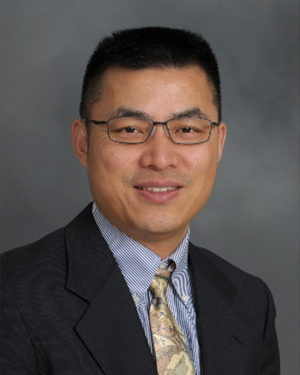
Associate Professor and Director of PET Chemistry at PET Research Core
Office Number: (631) 638-0045
Email: wenchao.qu@stonybrook.edu
Address: Stony Brook Medicine100 Nicolls Rd
MART Building 406B, Room 4M-0310
Stony Brook, NY 11794
Education
- Ph.D., Organic Chemistry, The University of Akron, 2001-2006
- MS, Applied Chemistry, Nanjing University of Science and Technology, 1996-1999
- BS, Fine Chemical Engineering, Nanjing University of Science and Technology, 1988-1992
Research Interests
- Developing new methodologies for fast and facile labeling bioactive molecules with radioisotopes (carbon-11; fluorine-18, radioactive iodine, bromine-76, etc.)
- Design and synthesis of radiolabeled indigenous biomolecules (amino acid, nucleoside, lipid, carboxylic acid, alcohol, sugar, peptide, etc.) and their analogs for diagnosis of chronic diseases.
- Design and synthesis of radiolabeled organic molecules for PET imaging of neurological and psychiatric disorders.
- cGMP production of Radiopharmaceuticals for clinical imaging and radiotherapy.
I was trained as a synthetic organic chemist and obtained my Ph.D. in 2006 at The University of Akron. Immediately after finishing Ph.D. training, I joined Dr. Hank F. Kung’s research group at University of Pennsylvania (Upenn) as a postdoctoral research fellow, and my major work was synthesizing drug-like molecules and evaluating them as potential imaging agents for diagnosis of Alzheimer’s Diseases (AD). In July 2008, I was promoted to Research Assistant Professor, and I kept working on radiopharmaceutical chemistry research at Upenn. In Oct. 2012, I joined in Dr. Joanna Folwer’s research program at Brookhaven National Laboratory as a tenure track Associate Chemist focusing on developing radiochemistry methodologies for synthesizing radiolabeled PET tracers for mapping biological activities in living organisms. In Oct. 2015, I moved to Citigroup Biomedical Imaging Center at Weill Cornell Medicine and switched my focus on developing various isotopically labeled organic molecules as imaging agents for detecting various chronic diseases as well as regularly producing carbon-11 and fluorine-18 labeled radiotracers for clinical and pre-clinical PET imaging studies following GMP production guidance. In Nov. 2019, I started my new position at Stony Brook University as an Associate Professor and Director of PET Chemistry. In addition to continuing my research on developing new radiolabeling methodologies and novel PET imaging agents for diagnosis of chronic diseases (cancer, infection and inflammation) and neurological and psychiatric diseases, I also oversee the radiotracer development and their regular cGMP production for supporting clinical PET imaging studies at SBU.
- “Fluoride-Mediated Desilylative Radiosynthesis of 11C-Labeled PET Tracers”; 05/2022-01/2026; NIBIB, 1 R01 EB031785-01A1; My role: PI.
- “Preliminary Imaging Studies of the Kappa Opioid Receptors in Schizophrenia and Their Relationship to Dopamine Function”; 12/2020-10/2022; NIMH, 1R21MH125454-01; PI: Anissa Abi-Dargham; My role: Co-PI
- “Development of Novel Ligands for Radioarsenic Complexation”; 07/2020-01/2022; SBU-BNL Seed Grant Award; My role: PI
- “Dual Isotopes Labeled Glutamines as Novel Cancer Imaging Agents”; 11/2020-10/2021; 2020 Targeted Research
- H. K. Akula, B. Hu, J. Brunner, K. Li, L. Saleh, P. Vaska, W. Qu*. Deuterium- and Fluorine-18-Labeled Glutamine-a PET Imaging Agent with Enhanced In Vivo Stability. ACS Omega 2025, (10), 29741.
- M.-J. Kim*, H. Akula, J. Marden, K. Li, B. Hu, P. Vaska, W. Qu*. The potential utility of [18F](2S,4R)-4-fluoroglutamine as a novel metabolic imaging marker for inflammation explored by rat models of arthritis and paw edema. Mol Imag and Bio, 2025, (1), https://doi.org/10.1007/s11307-024-01967-1.
- K. Li, J. T. Collado, J. A. Marden, A. C. Pollard, S. Guo, P. J. Tonge, W. Qu*. “Biological Evaluation of D-[18F]Fluoroalanine and D-[18F]Fluoroalanine-d3 as Positron Emission Tomography (PET) Imaging Tracers for Bacterial Infection”. J Med Chem. 2024, 67(16), 13975.
- K. Li, A. L. Gilberti, J. A. Marden, H. K. Akula, A. C. Pollard, S. Guo, B. Hu, P. J. Tonge, W. Qu*. “Synthesis and Biological Evaluation of Fluorine-18 and Deuterium Labeled L-Fluoroalanines as Positron Emission Tomography (PET) Imaging Agents for Cancer Detection”. J Med Chem. 2024, 67(12), 10293-10305.
- M Slifstein, W. Qu, R. Gil, J. J. Weinstein, G. Perlman, T. Jaworski-Calara, J. Meng, B. Hu, S. J. Moeller, G. Horga and A. Abi-Dargham. Kappa opioid receptor availability predicts severity of anhedonia in schizophrenia. Neuropsychopharmacology. 2024, 49, 2087.
- B. Hu, H. K. Akula, D. Noh, Y. F. Mui, M. Slifstein, R. Parsey, W. Qu*. An Improved Synthesis of [18F]VAT and Its Precursor. J Lab Compd Radiopharm. 2023; 66: 384.
- W. Qu*, B. Hu, J. W. Babich, N. Waterhouse, M. Dooley, S. Ponnala, J. Urgiles. “A general 11C-labeling approach enabled by fluoride-mediated desilylation of organosilanes”.Nat Comm. 2020, 11, 1736.
- Y. Xu, W. Qu*. “[11C]HCN Radiochemistry: Recent Progress and Future Perspectives.” Euro J Org Chem, 2021, 4653, Minireview.
- N. N. Waterhouse, P. J. Kothari, M. Dooley, B. Hu, M. J. De Leon, J. Babich, W. Qu*. Synthesis of [1-11C]Butanol via a Facile and cGMP-compliant Protocol. Applied Radiation and Isotopes. 2020 May, 159, 109078.
- Y. Xu, A. S. Cankaya, R. Hoque, S. J. Lee, C. Shea, L. Kersting, M. Schueller, J. S. Fowler, D. Szalda, D. Alexoff, B. Riehl, T. Gleede, R. A. Ferrieri, W. Qu*. Synthesis of L-[4-11C]Asparagine via Ring-Opening Nucleophilic 11C-Cyanation Reaction of a Chiral Cyclic Sulfamidate Precursor. Chem Euro J. 2018, 24, 6848.
Google Scholar Link: https://scholar.google.com/citations?user=2-uv9KsAAAAJ&hl=en
- Spotlight Award in recognition of exceptional job performance at BNL, 09/2014.
- Paper “PET Imaging of Glutaminolysis in Tumors by [18F](2S,4R)-4-Fluoroglutamine.” B. P. Lieberman, K. Ploessl, L. Wang, W. Qu, Z. Zha, D. R. Wise, L. A. Chodosh, G. Belka, C. B. Thompson, H. F. Kung. The Journal of Nuclear Medicine. 2011, 52, 1947-1955. Selected as The Editors’ Choice Award for one of the three best basic science investigation manuscripts published in JNM in 2011.
- 2004-Present: American Chemical Society
- 2007-Present: Society of Nuclear Medicine and Molecular Imaging
- 2009-Present: Society of Radiopharmaceutical Sciences