


Karam Aboudehen, PhD
Assistant Professor of Medicine
Division of Nephrology & Hypertension
Department of Medicine
Renaissance School of Medicine
101 Nicolls Rd, HSC T 15-103
Stony Brook University
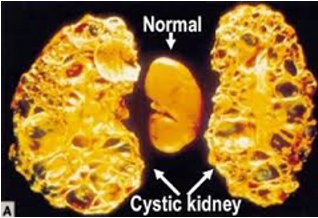
The Aboudehen Lab studies RNA biology in autosomal dominant polycystic kidney disease (ADPKD), with two major research themes: 1) understanding how long noncoding RNAs (lncRNAs) influence cystogenesis, and 2) defining how PKD1 mRNA is regulated to identify therapeutic strategies that increase polycystin-1 expression and rescue the disease.
ADPKD caused primarily by mutations in PKD1 and PKD2, yet disease severity varies widely among patients. This suggests that additional regulatory mechanisms modify cyst initiation, cyst growth, and the decline in kidney function. Our laboratory focuses on RNA-based regulation as an important class of disease-modifying mechanisms.
Our work is organized around two major research programs:
LncRNAs in PKD: how disease-associated lncRNAs regulate cystogenesis.
PKD1 mRNA biology and polycystin-1 dosage: how RNA-binding proteins, RNA-RNA interactions, and post-transcriptional mechanisms regulate PKD1 mRNA output and polycystin-1 production.
We aim to identify therapeutic strategies that restore protective RNA pathways or increase functional polycystin-1 dosage in ADPKD.
Research Area
Long Noncoding RNAs in ADPKD
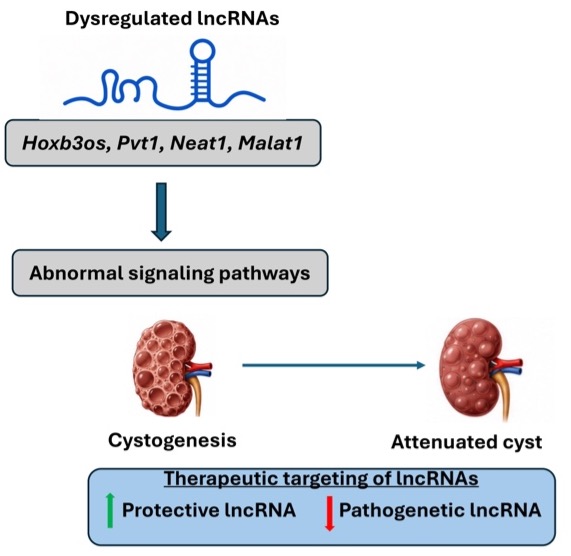
LncRNAs are powerful regulators of gene expression and cellular pathways, but their role and function in ADPKD remain incompletely understood. We investigate lncRNAs that are dysregulated in ADPKD and determine whether they promote, suppress, or modify cystogenesis. Our work has focused on several ADPKD-associated lncRNAs, including Hoxb3os, Pvt1, and Malat1, and Neat1. Using mouse genetics, kidney epithelial cell models, metanephric organ culture, transcriptomics, and molecular biology approaches, we study try to answer key questions:
How do lncRNAs regulate cyst initiation and progression?
Which lncRNAs are protective, and which promote disease?
What molecular pathways are controlled by ADPKD-associated lncRNAs?
Can lncRNAs themselves be therapeutically targeted by increasing protective lncRNAs or inhibiting pathogenic lncRNAs?
PKD1 mRNA Biology and Polycystin-1 Dosage
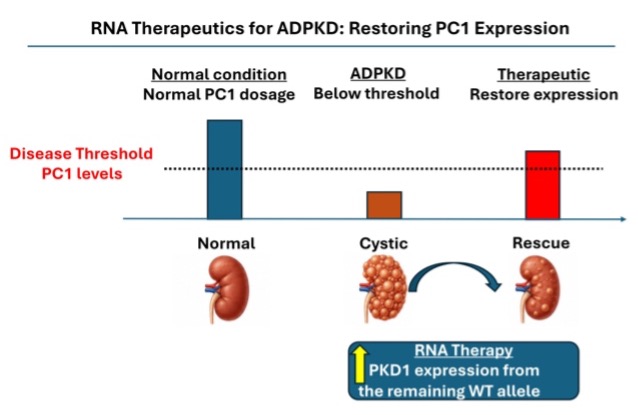
Genetic, experimental, and therapeutic evidence indicates that ADPKD is a polycystin-1 (PC1) dosage disease. Although patients with ADPKD inherit one mutant PKD1 allele and one remaining wild-type allele, cysts develop when functional PC1 levels fall below a critical threshold. This has shifted the field toward the idea that increasing expression from the remaining functional PKD1 allele may be therapeutically beneficial. Building on this concept, the Aboudehen Lab studies how endogenous mechanisms regulate PKD1 mRNA abundance, translation, and protein output. We are identifying RNA-binding proteins, RNA-RNA interactions, and regulatory elements within PKD1 mRNA that may limit polycystin-1 production. Our goal is to discover targetable RNA-based mechanisms that can be manipulated to increase PKD1 expression and rescue cystic disease.
Current Opportunities
The Aboudehen Lab is recruiting highly motivated graduate students and postdoctoral fellows, interested in RNA biology, kidney disease, and therapeutic discovery. We are especially interested in postdoctoral fellows with expertise in RNA biology, RNA-binding proteins, noncoding RNAs, transcriptomics, RNA-protein interactions, antisense oligonucleotides, or RNA-targeted therapeutic approaches. Candidates with experience in kidney biology, mouse models, organoids, or disease modeling are also encouraged to apply.
A. Senior / Corresponding or First Author Publications
D'Amico, S., Dar, U., Eckberg, K., Weisser, I., Hossain, C., Bronstein, R., & Aboudehen, K. (2026). Loss of Snhg5 disrupts cell-cycle regulation without altering cystogenesis in a mouse model of polycystic kidney disease. Sci Rep.
Weisser, I., Eckberg, K., D'Amico, S., Buttram, D., & Aboudehen, K. (2024). Ablation of Long Noncoding RNA Hoxb3os Exacerbates Cystogenesis in Mouse Polycystic Kidney Disease. J Am Soc Nephrol, 35(1), 41-55.
Eckberg, K., Weisser, I., Buttram, D., Somia, N., Igarashi, P., & Aboudehen, K. S. (2022). Small hairpin inhibitory RNA delivery in the metanephric organ culture identifies long noncoding RNA Pvt1 as a modulator of cyst growth. Am J Physiol Renal Physiol, 323(3), F335-F348.
Aboudehen, K. (2020). Regulation of mTOR signaling by long non-coding RNA. Biochim Biophys Acta Gene Regul Mech, 1863(4), 194449.
Aboudehen, K., Farahani, S., Kanchwala, M., Chan, S. C., Avdulov, S., Mickelson, A., Lee, D., Gearhart, M. D., Patel, V., Xing, C., & Igarashi, P. (2018). Long noncoding RNA Hoxb3os is dysregulated in autosomal dominant polycystic kidney disease and regulates mTOR signaling. Journal of Biological Chemistry, 293(24), 9388-9398.
Aboudehen, K., Noureddine, L., Cobo-Stark, P., Avdulov, S., Farahani, S., Gearhart, M. D., Bichet, D. G., Pontoglio, M., Patel, V., & Igarashi, P. (2017). Hepatocyte Nuclear Factor-1beta Regulates Urinary Concentration and Response to Hypertonicity. J Am Soc Nephrol, 28(10), 2887-2900.
Aboudehen, K., Kim, M. S., Mitsche, M., Garland, K., Anderson, N., Noureddine, L., Pontoglio, M., Patel, V., Xie, Y., DeBose-Boyd, R., & Igarashi, P. (2016). Transcription Factor Hepatocyte Nuclear Factor-1beta Regulates Renal Cholesterol Metabolism. J Am Soc Nephrol, 27(8), 2408-2421.
Aboudehen, K., Hilliard, S., Saifudeen, Z., & El-Dahr, S. S. (2012). Mechanisms of p53 activation and physiological relevance in the developing kidney. Am J Physiol Renal Physiol, 302(8), F928-940.
B. Co-Authored Publications
Ramalingam, H., Alvarez, J., Flaten, A., Cobo-Stark, P., Foster, N., Grilli, E., Lakhia, R., Aboudehen, K., Carroll, T., & Patel, V. (2025). An RNA transmethylation pathway governs kidney nephrogenic potential. Nat Commun, 16(1), 4930.
Piret, S. E., Aboudehen, K., & Agrawal, S. (2025). Evolving Understanding of RNA Biology in Kidney Disease. J Am Soc Nephrol.
Lakhia, R., Yheskel, M., Flaten, A., Ramalingam, H., Aboudehen, K., Ferre, S., Biggers, L., Mishra, A., Chaney, C., Wallace, D. P., Carroll, T., Igarashi, P., & Patel, V. (2020). Interstitial microRNA miR-214 attenuates inflammation and polycystic kidney disease progression. Jci Insight, 5(7).
Kompatscher, A., de Baaij, J. H. F., Aboudehen, K., Farahani, S., van Son, L. H. J., Milatz, S., Himmerkus, N., Veenstra, G. C., Bindels, R. J. M., & Hoenderop, J. G. J. (2018). Transcription factor HNF1beta regulates expression of the calcium-sensing receptor in the thick ascending limb of the kidney. Am J Physiol Renal Physiol, 315(1), F27-F35.
Chan, S. C., Zhang, Y., Shao, A., Avdulov, S., Herrera, J., Aboudehen, K., Pontoglio, M., & Igarashi, P. (2018). Mechanism of Fibrosis in HNF1B-Related Autosomal Dominant Tubulointerstitial Kidney Disease. J Am Soc Nephrol, 29(10), 2493-2509.
Kompatscher, A., de Baaij, J. H. F., Aboudehen, K., Hoefnagels, A., Igarashi, P., Bindels, R. J. M., Veenstra, G. J. C., & Hoenderop, J. G. J. (2017). Loss of transcriptional activation of the potassium channel Kir5.1 by HNF1beta drives autosomal dominant tubulointerstitial kidney disease. Kidney Int, 92(5), 1145-1156.
Hajarnis, S., Lakhia, R., Yheskel, M., Williams, D., Sorourian, M., Liu, X., Aboudehen, K., Zhang, S., Kersjes, K., Galasso, R., Li, J., Kaimal, V., Lockton, S., Davis, S., Flaten, A., Johnson, J. A., Holland, W. L., Kusminski, C. M., Scherer, P. E., Patel, V. (2017). microRNA-17 family promotes polycystic kidney disease progression through modulation of mitochondrial metabolism. Nat Commun, 8, 14395.
Lakhia, R., Hajarnis, S., Williams, D., Aboudehen, K., Yheskel, M., Xing, C., Hatley, M. E., Torres, V. E., Wallace, D. P., & Patel, V. (2016). MicroRNA-21 Aggravates Cyst Growth in a Model of Polycystic Kidney Disease. J Am Soc Nephrol, 27(8), 2319-2330.
Hajarnis, S. S., Patel, V., Aboudehen, K., Attanasio, M., Cobo-Stark, P., Pontoglio, M., & Igarashi, P. (2015). Transcription Factor Hepatocyte Nuclear Factor-1beta (HNF-1beta) Regulates MicroRNA-200 Expression through a Long Noncoding RNA. Journal of Biological Chemistry, 290(41), 24793-24805.
Williams, S. S., Cobo-Stark, P., Hajarnis, S., Aboudehen, K., Shao, X., Richardson, J. A., Patel, V., & Igarashi, P. (2014). Tissue-specific regulation of the mouse Pkhd1 (ARPKD) gene promoter. Am J Physiol Renal Physiol, 307(3), F356-368.
El-Dahr, S., Hilliard, S., Aboudehen, K., & Saifudeen, Z. (2014). The MDM2-p53 pathway: multiple roles in kidney development. Pediatr Nephrol, 29(4), 621-627.
Saifudeen, Z., Liu, J., Dipp, S., Yao, X., Li, Y., McLaughlin, N., Aboudehen, K., & El-Dahr, S. S. (2012). A p53-Pax2 pathway in kidney development: implications for nephrogenesis. PLoS One, 7(9), e44869.
Hilliard, S., Aboudehen, K., Yao, X., & El-Dahr, S. S. (2011). Tight regulation of p53 activity by Mdm2 is required for ureteric bud growth and branching. Developmental Biology, 353(2), 354-366.
Goldfarb, A. H., Garten, R. S., Chee, P. D., Cho, C., Reeves, G. V., Hollander, D. B., Thomas, C., Aboudehen, K. S., Francois, M., & Kraemer, R. R. (2008). Resistance exercise effects on blood glutathione status and plasma protein carbonyls: influence of partial vascular occlusion. European Journal of Applied Physiology, 104(5), 813-819.
El-Dahr, S. S., Aboudehen, K., & Saifudeen, Z. (2008). Transcriptional control of terminal nephron differentiation. Am J Physiol Renal Physiol, 294(6), F1273-1278.
El-Dahr, S. S., Aboudehen, K., & Dipp, S. (2008). Bradykinin B2 receptor null mice harboring a Ser23-to-Ala substitution in the p53 gene are protected from renal dysgenesis. Am J Physiol Renal Physiol, 295(5), F1404-1413.
Howard, G. T., Mackie, R. I., Cann, I. K., Ohene-Adjei, S., Aboudehen, K. S., Duos, B. G., & Childers, G. W. (2007). Effect of insertional mutations in the pueA and pueB genes encoding two polyurethanases in Pseudomonas chlororaphis contained within a gene cluster. Journal of Applied Microbiology, 103(6), 2074-2083.
Doughty, M. B., Aboudehen, K., Anderson, G., Li, K., Moore, B., 2nd, & Poolson, T. (2004). Side-chain conformational restriction in template-competitive inhibitors of E. coli DNA polymerase I Klenow fragment: synthesis, structural characterization and inhibition activity. Nucleosides Nucleotides Nucleic Acids, 23(11), 1751-1765.
Kraemer, R. R., Aboudehen, K. S., Carruth, A. K., Durand, R. T., Acevedo, E. O., Hebert, E. P., Johnson, L. G., & Castracane, V. D. (2003). Adiponectin responses to continuous and progressively intense intermittent exercise. Medicine & Science in Sports & Exercise, 35(8), 1320-1325.
ORCID: https://orcid.org/0000-0003-4975-464X
Pubmed: https://www.ncbi.nlm.nih.gov/myncbi/14KZgwo9wankz/bibliography/public/
Funding
Research in the Aboudehen Laboratory is supported by the National Institute of Diabetes and Digestive and Kidney Diseases (NIDDK), National Institutes of Health (R01DK143971), the PKD Foundation, the Mayo Clinic, and Stony Brook University.
Lab Members
Current
Stephen D’Amico, PhD
Senior Research Support Specialist
Project: lncRNA in PKD
Zijun Zhou, BS
Research Support Specailst
Project: RNA binding proteins in PKD
Jessy Zhang
Senior undergraduate student
Project: RNA biology in PKD
SOAR Awardee
Stacey Chung
Senior undergraduate student
Project: RNA biology in PKD
Lab alumni and former trainees
Ujala Dar
Former undergraduate student and research support specialist
Project: Snhg5 and ADPKD
URECA Awardee
Current position: Medical student
Ilona Lakusta
Former undergraduate student
Project: ADPKD-related research
Current position: Applying to medical school
Chandrema Hossain
Former undergraduate student
Project: Snhg5/ADPKD-related research
Current position: Medical student
Kara Eckberg
Former senior researcher
Project: Metanephric organ culture and lncRNA/Pvt1 research
Current position: Genetic counselor
Sophia Verba
Former undergraduate student
Project: lncRNA and kidney disease research
Current position: Medical student
Annie Shao
Former PhD candidate
Project: Kidney/PKD research
Current position: Technician
Shayan Farahani
Former undergraduate student
Project: lncRNA and kidney disease research
David Stagg
Former MD-PhD candidate
Project: Kidney/PKD research
Current position: Residency