

Long Noncoding RNAs in ADPKD
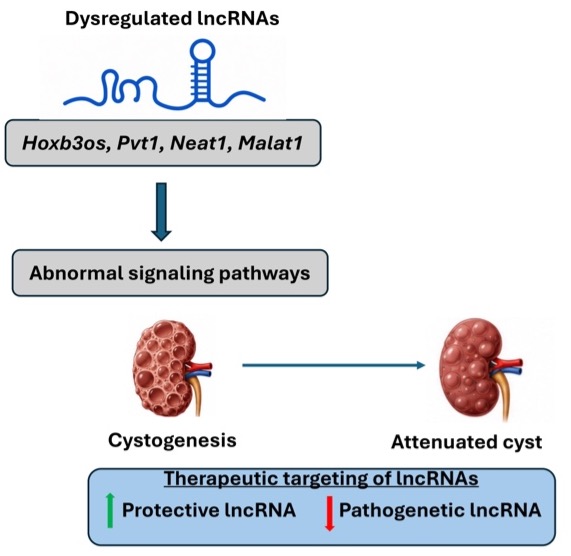
LncRNAs are powerful regulators of gene expression and cellular pathways, but their role and function in ADPKD remain incompletely understood. We investigate lncRNAs that are dysregulated in ADPKD and determine whether they promote, suppress, or modify cystogenesis. Our work has focused on several ADPKD-associated lncRNAs, including Hoxb3os, Pvt1, and Malat1, and Neat1. Using mouse genetics, kidney epithelial cell models, metanephric organ culture, transcriptomics, and molecular biology approaches, we study try to answer key questions:
How do lncRNAs regulate cyst initiation and progression?
Which lncRNAs are protective, and which promote disease?
What molecular pathways are controlled by ADPKD-associated lncRNAs?
Can lncRNAs themselves be therapeutically targeted by increasing protective lncRNAs or inhibiting pathogenic lncRNAs?
PKD1 mRNA Biology and Polycystin-1 Dosage
Genetic, experimental, and therapeutic evidence indicates that ADPKD is a polycystin-1 (PC1) dosage disease. Although patients with ADPKD inherit one mutant PKD1 allele and one remaining wild-type allele, cysts develop when functional PC1 levels fall below a critical threshold. This has shifted the field toward the idea that increasing expression from the remaining functional PKD1 allele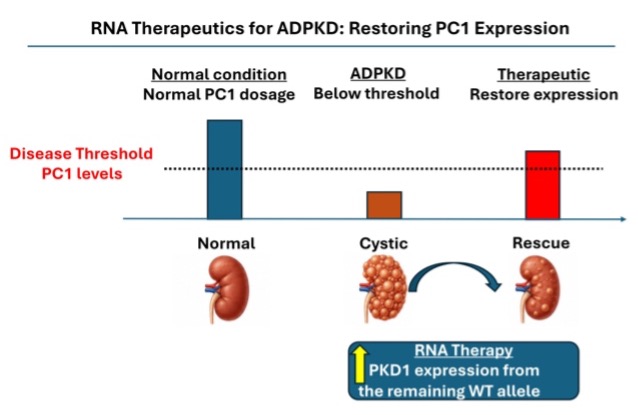 may be therapeutically beneficial. Building on this concept, the Aboudehen Lab studies how endogenous mechanisms regulate PKD1 mRNA abundance, translation, and protein output. We are identifying RNA-binding proteins, RNA-RNA interactions, and regulatory elements within PKD1 mRNA that may limit polycystin-1 production. Our goal is to discover targetable RNA-based mechanisms that can be manipulated to increase PKD1 expression and rescue cystic disease.