Kanokporn Noy Rithidech, PhD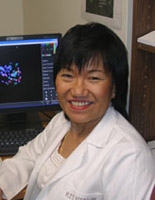
Professor of Research Pathology
Basic Sciences Tower, Level 9
Stony Brook Medicine
Stony Brook, NY 11794-8691
Tel: (631) 444-3446
Fax: (631) 444-3424
E-mail: Kanokporn.Rithidech@stonybrookmedicine.edu
Research Summary:
I am a radiation biologist with extensive scientific knowledge that enables me to conduct research across various medical disciplines. My current focus is on radiation countermeasures and radio/chemosensitizers for cancer treatment. The susceptibility of different human populations, including military personnel and veterans, to radiation exposure has become a significant public health concern both on Earth and in space. I am actively seeking compounds that can protect individuals from radiation-induced injuries. I have made notable progress in identifying the radioprotective and mitigating properties of apigenin (AP), which is classified as a class II drug. I was the first to demonstrate the in vitro radioprotection of human lymphocytes by AP and to report its in vivo mitigative effects when administered to irradiated mice. Recently, I also documented the efficacy of AP as a dietary supplement in counteracting injuries to the hematopoietic tissue and gut in mice exposed to space-like radiation. These findings illustrate the effectiveness of AP across different tissues, which is characteristic of an ideal radiation countermeasure. Moreover, I discovered that AP can restore the homeostasis of the gut microbiome in mice exposed to space radiation and reduce the incidence of acute leukemia/lymphoma when included in their daily diet. These results highlight the potent chemopreventive activity of AP.
I recently completed molecular docking studies that demonstrated the high inhibitory activity of AP and certain flavonoids against various proteins associated with human diseases, including KRAS mutants found in different solid tumors, such as pancreatic ductal adenocarcinoma (PDAC). The findings from my laboratory support the notion that AP has the potential to effectively limit the cancer-causing effects of specific KRAS mutations in these tumors, thereby enhancing the efficacy of chemotherapy and radiotherapy. This strategy could lead to more successful treatment outcomes for cancer patients with KRAS mutations. Additionally, I discovered that AP treatment can improve the effectiveness of radiation therapy in in vitro systems. Given AP's favorable safety profile, my findings are significant for the development of flavonoid-based drugs, whether used alone or in combination, to reduce side effects and overcome cancer cell resistance to conventional chemotherapy and radiation therapy.
| Education: | ||||
| Institution and Location | Degree | Year(s) | Field of Study | |
| Chulalongkorn University, Thailand | B.S. (Hon.) | 1969 | General Sciences | |
| University of the Philippines, Philippines | M.S. | 1973 | Cytogenetics | |
| University of Texas Medical Branch, TX | Ph.D. | 1987 | Genetic Toxicology | |
| Inhalation Toxicology Research Inst., Lovelace Biomed. and Environmental Research Inst., NM | Postdoctoral | 1988 | Molecular and Cellular Toxicology | |
| Positions and Employment: | ||||
| 2011-present | Professor of Research Pathology, Department of Pathology, SBUMC, NY | |||
| 2011 | Adjunct Professor, Graduate Program in Radiologic Technology, Chiang Mai University, Thailand | |||
| 2004-10 | Associate Professor of Research Pathology, Department of Pathology, SBUMC, NY | |||
| 2010-present | Adjunct Professor, Graduate Program in Applied Radiation and Isotopes, Kasetsart University, Thailand | |||
| 2008-present | Adjunct Professor, Graduate Program in Applied Radiation and Isotopes, Kasetsart University, Thailand | |||
| 1997-present | Guest Scientist, Biology Department, Brookhaven National Laboratory, NY | |||
| 1999-present | Adjunct Professor, Graduate Program, Burapha University, Thailand | |||
| 1997-2004 | Assistant Professor of Research Pathology, Department of Pathology, SBUMC, NY | |||
| 1994-97 | Full Scientist, Medical Department, Brookhaven National Laboratory, NY | |||
| 1992 | Visiting Scientist, University of Bern, Switzerland | |||
| 1991-94 | Associate Scientist, Medical Department, Brookhaven National Laboratory, NY | |||
| 1989-91 | Assistant Scientist, Medical Department, Brookhaven National Laboratory, NY | |||
| 1969-80 | Instructor, Applied Radio-isotope Division, Faculty of Sciences, Kasetsart University, Thailand | |||
| Other Experience and Professional Memberships (selected): | ||||
| 2010-present | Member of the National Space Biomedical Research Institute Review Panel | |||
| 2003 | Member of the Review Panel for the NIH/NCI, Special Emphasis Research Programs | |||
| 2007-present | The International Dose Response Society | |||
| 2007-present | The Epigenetic Society | |||
| 1987-present | The Environmental Mutagen Society | |||
| 1990-present | The Radiation Research Society | |||
| Honors (selected): | ||||
| 1971-73 | The Southeast Asian Research Center for Agriculture Scholarship to pursue Master degree at University of the Philippines | |||
| 1977 | The Columbo Plan Scholarship (sponsored by Australian Government) to attend course "The Use of Radioisotopes" at the Australian School of Nuclear Technology | |||
| 1987 | Doctor Edward Storrs Reynolds, Jr., Memorial Award for Best Research in Toxicology, University of TX | |||
| 1989 | The National Cancer Institute to attend Workshop on Somatic Cell Genetics and Molecular Biology, The Eleanor Roosevelt Institute | |||
| 2008 | The Highest Recognition in Science by Town of Brookhaven Annual Women’s Recognition | |||
Peer Reviewed Publications: