

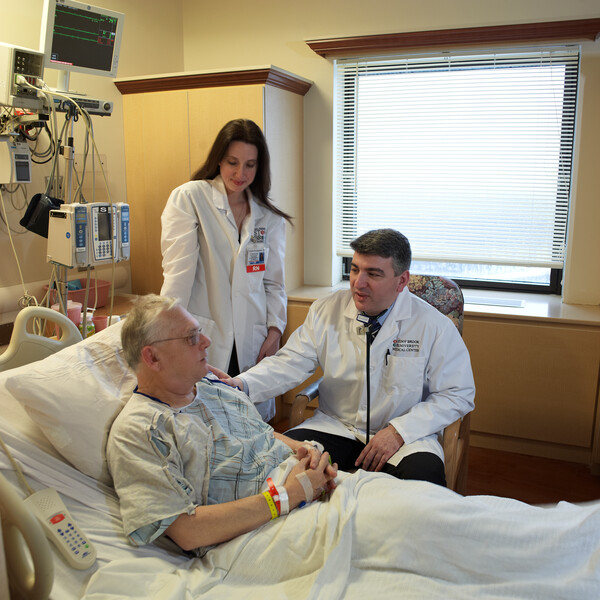
 Phase II begins with a two-week Transition to Clinical Care (TCC) course in which students acquire the skills to function effectively in the clinical environment. Focus is on communication skills, professional identity formation, clinical documentation, case presentation skills, learning environment, academic success, patient care quality, humanism, and other clinical skills.
Primary Clinical Clerkships
The TCC course is followed by Primary Clinical Clerkships, which are aligned in four 12-week blocks:
Block 1: Medicine (8 weeks) and Primary Care (4 weeks);
Block 2: Pediatrics (6 weeks) and Ob-Gyn (6 weeks);
Block 3: Surgery (8 weeks), Anesthesia (2 weeks) and Emergency Medicine (2 weeks);
Block 4: Psychiatry (6 weeks), Neurology (4 weeks) and Radiology (2 weeks)
Blocks 1 through 3 are each capped by a wellness week, during which students may take time to relax and recharge with family and friends or participate in self-directed activities. Following the fourth clerkship block, students begin their dedicated Step exam prep period.
The Phase II core clinical clerkships (Medicine, Primary Care, Ob/Gyn, Pediatrics, Neurology, Psychiatry, Surgery) are graded Honors/High Pass/Pass/Low Pass/Fail. The two-week mini-clerkships (Emergency Medicine, Anesthesiology, Radiology) and the Transition to Clinical Care course are graded Pass/Fail.
Core clerkships require the successful completion of the NBME subject exams for a pass grade. Each core clerkship has a specific set of clinical skills and clinical conditions that students must encounter and document electronically. Students are given access to electronic cases and materials to augment their clinical experience.
During the fourth clerkship block, students take the summative Clinical Performance Exam, which they must pass.
Clinical Training
Stony Brook University Hospital (SBUH) is Long Island’s premier academic medical center. With 628 beds, SBUH serves as the region’s only tertiary care center and Level 1 Regional Trauma Center and is home to the Stony Brook University Heart Institute, Stony Brook University Cancer Center, Stony Brook Children’s Hospital and Stony Brook University Neurosciences Institute. SBUH also encompasses Suffolk County’s only Level 4 Regional Perinatal Center, state-designated AIDS Center, state-designated Comprehensive Psychiatric Emergency Program, state-designated Burn Center, the Christopher Pendergast ALS Center of Excellence, and Kidney Transplant Center. It is also home of the nation’s first Pediatric Multiple Sclerosis Center.
Stony Brook Southampton Hospital (SBSHH), a campus of Stony Brook University Hospital, offers a diverse array of clinical services, ranging from primary medical care to specialized surgical procedures, including orthopedics and bariatrics. The sole provider of emergency care on Long Island’s South Fork, Stony Brook Southampton Hospital is a provisional Level III adult Trauma Center. The hospital includes a Heart and Stroke Center, Breast Health Center, The Center for Advanced Wound Healing, and 32 satellite care centers throughout the South Fork of Long Island.
Stony Brook Eastern Long Island Hospital (SBELIH) is an acute care community hospital committed to delivering excellence in patient care and meeting the current and emerging health needs of the North Fork and Shelter Island. A campus of Stony Brook University Hospital, SBELIH provides regional behavioral health programs serving the greater Suffolk County area. Centers of excellence include Medical-Surgical, Advanced Ambulatory Care, Behavioral Health, Emergency, Geriatric, Diagnostic Services, Physical Therapy and Gastrointestinal Services.
Clinical Affiliates
Renaissance School of Medicine at Stony Brook University has established affiliations with other institutions and agencies. These affiliates serve as major resources for the educational, research, and clinical programs of the school.
Nassau University Medical Center (NUMC) includes a 615-bed acute care facility integrated with a network of ambulatory primary care and specialty sites. NUMC also has an 889-bed long-term care facility.
Northport Veterans Affairs Medical Center (VAMC) provides a full range of services, with state-of-the-art technology as well as education and research. VAMC operates a 508-bed acute care hospital, a 190-bed nursing care home facility, and five community-based outpatient clinics.
Course specific information is detailed below:
TCC is a 2-week course offered at the beginning of Phase II of medical school. It is a preparatory course designed to equip students with the foundational knowledge, skills, and professional behaviors necessary for success during the clinical clerkship phase of the curriculum. The course provides an orientation to Phase II clinical training, including clerkship structure, assessment methods, professionalism expectations, reflective practice, and NBME subject examinations. Through interactive learning experiences, students further develop essential interpersonal and communication skills, strengthen their ability to document and present patient information, and gain practical competency in basic and advanced life support concepts. The course also addresses important topics such as student mistreatment recognition and reporting, professional identity formation, and career planning through structured residency preparation activities. By integrating clinical skills development, professional standards, and career readiness, the course serves as a bridge between preclinical education and direct patient care experiences.
The Internal Medicine Clerkship is an eight-week clinical experience that provides students with supervised exposure to the evaluation and management of adult patients with a wide range of acute and chronic medical conditions. Through rotations in general internal medicine and medical subspecialties at Stony Brook University Hospital, Mather Hospital, Nassau University Medical Center, and the Northport VA Medical Center, students develop skills in history-taking, physical examination, clinical reasoning, diagnostic interpretation, and evidence-based patient management. Students participate as members of interdisciplinary healthcare teams, following patients longitudinally, formulating differential diagnoses and treatment plans, and presenting cases during rounds and conferences. The clerkship emphasizes patient-centered care, effective communication, professionalism, lifelong learning, and the integration of clinical evidence into the prevention, diagnosis, and treatment of disease.
The Primary Care Clerkship is a four-week outpatient clinical experience that provides students with supervised exposure to the prevention, diagnosis, and longitudinal management of common medical conditions in ambulatory practice. Working closely with preceptors in General Internal Medicine and Family Medicine, students develop skills in patient interviewing, physical examination, chronic disease management, preventive care, health promotion, and shared decision-making. Through direct patient care, case-based learning, geriatric assessment activities, hospice experiences, and interdisciplinary collaboration, students gain experience managing common outpatient conditions while developing an appreciation for continuity of care and the long-term physician–patient relationship. The clerkship emphasizes patient-centered care, effective communication, evidence-based practice, and the biopsychosocial approach to promoting health and preventing disease across the lifespan.
Neurology Clerkship is a four-week clinical experience integrated within a six-week Neurology–Radiology block that provides students with supervised exposure to the evaluation, diagnosis, and management of patients with neurologic disorders. Students rotate through inpatient and outpatient neurology settings at Stony Brook University Hospital and affiliated community practices, gaining experience in general neurology, stroke, neurocritical care, pediatric neurology, and consultative neurology. Through direct patient care, neurologic examinations, case-based learning, didactic sessions, and clinical reasoning exercises, students develop skills in neurologic localization, differential diagnosis, diagnostic interpretation, and patient management. The clerkship emphasizes evidence-based practice, effective communication, professionalism, and the integration of foundational neuroscience with patient-centered clinical care.
This clerkship provides a six-week comprehensive view of Obstetrics and Gynecology. The experience offers students basic information regarding women's health issues needed by any practicing physician in any specialty in addition to surgical interventions that are commonly performed for these medical issues. Routine care and emergency issues will be reviewed to provide students a scaffolding of knowledge to allow them to provide safe and effective care to women of all ages, backgrounds and identities. The clerkship also to exposes students to the depth and breadth of the field as a possible career: Maternal Fetal Medicine (high risk obstetrics); Reproductive Endocrinology and Infertility; Minimally Invasive Surgery; Family Planning; Gynecologic Oncology; and Female Pelvic Medicine and Reconstructive Surgery.
This clerkship provides a six-week comprehensive introduction to General Pediatric Medicine through clinical experiences, medical record keeping, case presentations, didactic lectures and conferences. This experience provides students with a positive perspective of Pediatrics, both as a specialty and as a potential career opportunity. The curricular content of this rotation is primarily based on recommendations put forth by the Council on Medical Student Education in Pediatrics (COMSEP). The Pediatrics Clerkship consists of inpatient, outpatient and newborn nursery rotation. During the clerkship, students have the opportunity to work with a variety of faculty and resident preceptors.
The Psychiatry Clerkship is a six-week clinical experience that provides students with supervised exposure to the evaluation, diagnosis, and treatment of patients with psychiatric disorders. Students rotate through diverse clinical settings at Stony Brook University Hospital and Nassau University Medical Center, including inpatient, outpatient, consultation-liaison, child, emergency, and specialty mental health services. Through direct patient care, interdisciplinary team-based learning, didactic sessions, and case discussions, students develop skills in psychiatric assessment, mental status examination, clinical reasoning, and psychopharmacologic management. The clerkship emphasizes effective communication, professionalism, empathy, and the integration of biological, psychological, and social factors in delivering patient-centered mental health care.
Surgery Clerkship is an eight-week core clinical rotation that provides students with supervised experience in the evaluation, diagnosis, and management of patients with surgical diseases. Students rotate through Stony Brook University Hospital, Nassau University Medical Center, and the Northport VA Medical Center, gaining exposure to a broad range of general and specialty surgical services. Through direct patient care, operating room experiences, procedural skills training, preceptor-led learning, and didactic sessions, students develop competencies in patient assessment, perioperative management, clinical decision-making, and surgical procedures. The clerkship emphasizes the care of patients with acute surgical conditions, trauma, malignancies, vascular disease, hernias, and other disorders requiring surgical intervention while fostering professionalism, teamwork, and evidence-based patient care.
The Emergency Medicine Mini-Clerkship is a two-week clinical experience at Stony Brook University Hospital that introduces students to the rapid assessment and management of acutely ill and injured patients in the emergency department. Students evaluate patients with a wide range of presenting complaints, develop differential diagnoses, formulate diagnostic and treatment plans, and participate in emergency procedures under the supervision of emergency medicine faculty and residents. Through clinical shifts, simulation exercises, and team-based patient care, students develop skills in acute care decision-making, stabilization, resuscitation, patient safety, and effective communication while gaining an appreciation for the unique role of emergency medicine in delivering timely and comprehensive patient care.
The Anesthesiology Clerkship is a two-week clinical experience that introduces students to the perioperative care of patients and the principles of anesthetic management in the operating room, labor and delivery unit, and pain management settings. Students develop skills in patient assessment, airway management, vascular access, physiologic monitoring, and the management of acute and chronic pain through direct participation in patient care and interdisciplinary team-based practice. The clerkship emphasizes perioperative decision-making, patient safety, effective communication, and the recognition and management of common clinical problems such as hypoxia, hemodynamic instability, and pain. Through supervised clinical experiences, students gain an appreciation for the anesthesiologist’s role in optimizing patient outcomes across a variety of procedural and surgical settings.
Radiology Mini-Clerkship Radiology Clerkship is a two-week clinical experience that introduces students to the principles and practice of diagnostic imaging. Through daily lectures, image review sessions, and participation in radiology subspecialty services, students develop skills in image interpretation, radiologic anatomy, diagnostic reasoning, and the appropriate selection of imaging studies. The clerkship provides exposure to radiography, ultrasound, computed tomography, magnetic resonance imaging, and image-guided procedures while emphasizing the role of medical imaging in patient evaluation, diagnosis, and clinical decision-making. Students also gain experience working with radiologists and other healthcare professionals as part of a multidisciplinary approach to patient care.