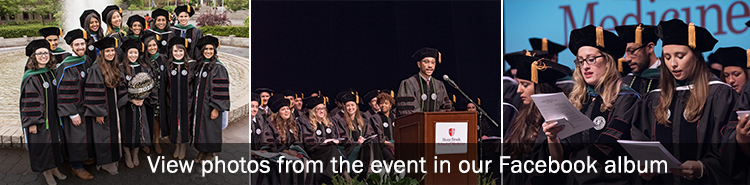
At the Stony Brook University School of Medicine’s May 18 convocation, 126 medical students became new physicians, ready to find better ways to treat, understand and prevent human diseases.
The graduates will begin their residency training in July. Approximately half will practice at hospitals and academic medical centers in New York State, and the rest at facilities nationwide. Overall the graduates will practice in 20 specialties, including internal medicine, pediatrics, surgery, psychiatry, anesthesiology and emergency medicine.
“This is a day of celebration amidst your years of hard work, dedication and commitment to the field you are entering,” said Kenneth Kaushansky, MD, Senior Vice President for the Health Sciences and Dean of the School of Medicine, as he addressed the graduates. “Medicine is a rapidly changing and dynamic landscape. It is truly a field in which you will transform the lives of your patients and embrace lifelong learning.”
Dr. Kaushansky noted that the 126-member Class of 2018 represents the best and brightest of 5,454 applicants to the School of Medicine four years ago. (Only 753 of that group were selected to be interviewed for admission.) He called the new MDs “inquisitive, compassionate and caring physicians.”
Convocation speaker Wilson M. Compton, MD, MPE, Deputy Director of the National Institute of Health’s National Institute on Drug Abuse (NIDA), addressed the opioid crisis in the United States, a problem he said the new MDs can help solve. Dr. Compton urged the graduates to follow their passions in medicine as a pathway to new discoveries, new treatments and disease prevention.
Among the graduates were seven members – a record number – of the university’s Scholars for Medicine program. They began their academic careers at Stony Brook University eight years ago, as enrollees in a program that recruits exceptional high school students into a combination bachelors and medical degree curriculum. While completing undergraduate studies, Scholars for Medicine participate in medical school classes and activities. Admission to the medical school is contingent on achieving a minimum G.P.A. of 3.4 and above average MCAT scores.
Among the Class of 2018, this year’s Scholars for Medicine were Kevin Elaahi, Anjali Kapur, Surinda Moonga, Elizabeth Olsen, Gayatri Setia, Achal Shah and Nimali Weerasooriya.
Surinda Moonga said he was inspired to study medicine by his grandfather, who was a maxillofacial surgeon in India. He was unable to practice medicine for much of his life, because of ethnic discrimination, but prevailed and eventually opened a clinic.
“This story was pretty inspiring, and made me want to become a doctor,” Surinda said. “I wanted the opportunity to help those who are suffering.” He was hooded by his father, Baljit Singh Moonga, PhD, who also practices medicine and is a researcher.
Elizabeth Olsen received her doctoral hood from her mother, Anna Marie Scopellito-Olsen, MD – a Stony Brook University School of Medicine alumna. Of the Scholars for Medicine program, Olsen said, “It enabled me to have a rich, well-rounded college experience and pursue opportunities, such as studying abroad in Ireland and conducting research.” Scholars for Medicine also helped Olsen and her classmates network and find peer mentors, she said.
Nimali WeerasooriyaI said the eight-year education provided by the program “created a strong foundation of basic sciences, humanities and medical knowledge to make me a well-rounded physician with the confidence to go into residency knowing I had excellent training.”
Dr. Kaushansky thanked the families and friends of the graduates, for their devoted support of their loved ones’ medical journeys. Then he turned his attention back to the graduates.
“Recall what Michelangelo said: ‘The greater danger for most of us lies not in setting our aim too high and falling short, but in setting our aim too low, and achieving our mark,’“ Dr. Kaushansky said.