

The Stony Brook University Pediatrics Residency Program provides the residents with a well-rounded training in general pediatrics. A significant amount of our training takes place in the ambulatory setting.
Ambulatory General Pediatrics
Our residents spend a total of eight weeks in outpatient primary care pediatrics on an Ambulatory General Pediatrics rotation which is spread out over the course of their three years of training. This rotation provides valuable exposure to a diverse range of outpatient practice sites and faculty physicians, broadening their clinical experiences beyond those gained in the Resident Continuity Practice. By working in different settings and caring for varied patient populations, residents develop a deeper understanding of community-based pediatric care and the unique challenges and opportunities within outpatient medicine.
As senior residents, they spend approximately half of the rotation serving in a supervisory role, providing guidance and support to junior residents and learners. This experience allows them to further develop their teaching, leadership, and practice management skills while strengthening their ability to oversee patient care in the outpatient setting. Through this progressive responsibilitiy, residents gain confidence in managing clinical workflows, and mentoring colleagues.
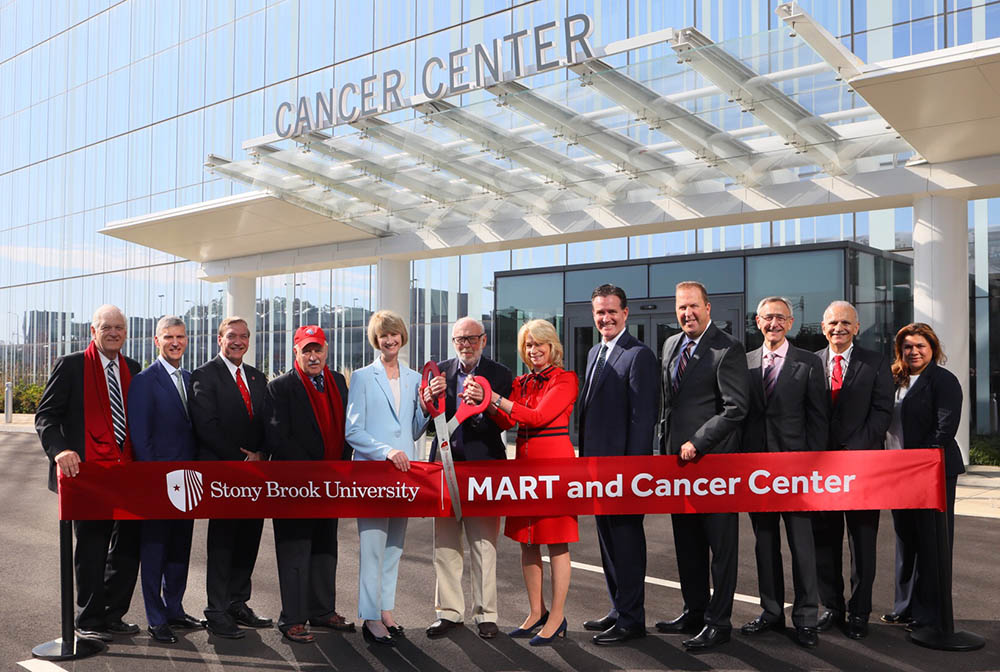
Stony Brook Cancer Center
The Cancer Center is a comprehensive cancer program backed by university-based research. The Stony Brook Cancer Center, well known for its excellence in scientific research, provides an integrated framework for care and promotes multidisciplinary and translational research, ensuring that results from the research bench are quickly incorporated into more effective therapies. The Pediatric Hematology/Oncology program is a multidisciplinary team that provides care to children and young adults with hematologic and oncologic disorders. Faculty are members of the internationally renowned Children’s Oncology Group. Clinical programs exist for Survivorship, Palliative Care, Adolescent and Young Adult Oncology and Hemoglobinopathies.
Division of Child and Adolescent Psychiatry (CAP)
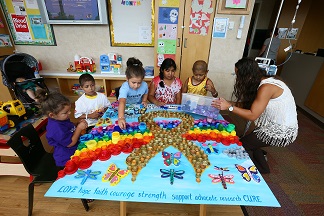
The Division of Child and Adolescent Psychiatry (CAP) within the Department of Psychiatry offers a variety of services for children and teens with mental health concerns and their families. The children’s inpatient unit on 12N is a 10-bed unit that treats children from ages 5-12 with the most severe problems, most typically aggression and suicidal behaviors. The outpatient clinic located in Putnam Hall on the South Campus of the University is staffed by CAP attendings, fellows, NPs, psychologists, and social workers who offer diagnostic evaluations, school consultations, medication management, and behavioral therapies for children and teens from infancy up to 18 years of age. In addition to treating children with a variety of disorders including ADHD, anxiety disorders, depression, tic disorders, OCD, and PTSD, there is an Autism Spectrum Disorders team that includes a developmental pediatrician. Consultation liaison services include providing evaluations and consultations for children and teens on the pediatrics inpatient units, as well as two CAP attending physicians and one fellow embedded in three therapeutic Western Suffolk BOCES special education schools.
Pediatric Multiple Sclerosis Center
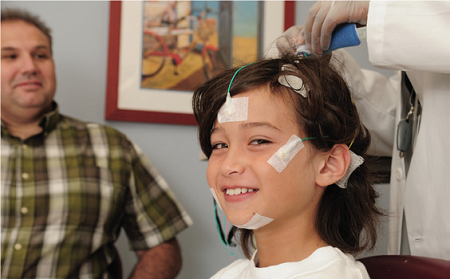
The National Pediatric Multiple Sclerosis (NPMS) Center, the first of its kind in the nation to address pediatric MD, was started by Dr. Lauren Krupp, an internationally recognized expert in MS.
Care is led by the director of MS with an assembly of the Lourie Center for Pediatric MS with an assembly of multi-disciplinary team of experts including MS specialists, pediatric neurology, neuropsychology, pediatric nursing, child psychiatry, and neuroradiology.
The team’s goals are to provide outstanding clinical care and to identify the biological changes in children facing MS; to advance research that could make a dramatic difference in their lives; and ultimately find the answers to MS. We are recognized as a Center of Excellence by the National Multiple Sclerosis Society. Pediatric patients who come to our Center receive a comprehensive multi-disciplinary evaluation, conducted over one to two days.
This includes:
- Extensive neurological assessment
- Neuropsychological evaluation and psychological assessment to evaluate the effects of MS on cognition, academic performance, and emotional functioning
- Ophthalmology
- Radiology
- Nursing case management
Cystic Fibrosis (CF) Center
Steadily improving treatment is helping cystic fibrosis patients live longer and enjoy a better quality of life. The average expectancy for someone with cystic fibrosis has changed dramatically since the 1980s and continues to increase over time.
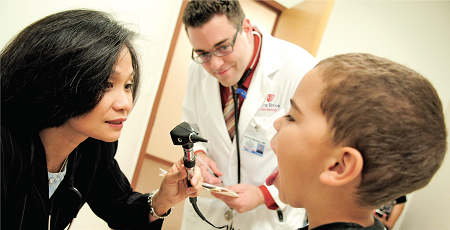
The Cystic Fibrosis Center at Stony Brook Children’s is one of approximately 120 such centers in the country accredited by the Cystic Fibrosis Foundation. This means that the center offers comprehensive care and the latest protocols following Cystic Fibrosis Foundation guidelines. Stony Brook also is a designated Center of Excellence by the New York Department of Health for cystic fibrosis. In addition, the center is one of only 16 facilities in the nation selected to participate in a leadership and learning collaborative sponsored by the Cystic Fibrosis Foundation. Members share quality improvement initiatives, evidence-based care practices and research designed to provide better patient care. Currently, Stony Brook is examining pulmonary exacerbation and education of our CF patients regarding their care when they are sick. Another hallmark of quality care at the Cystic Fibrosis Center is its team approach. This involves physicians, nurse practitioners, respiratory and pulmonology function therapists, physical therapists, social workers, a mental health coordinator, a nutritionist and a genetic counselor. Together with the patient and family, the care team constantly refines treatment plans to reflect the changing needs of children as they grow. With more patients living longer, the center also serves adults with cystic fibrosis, as well as children and adolescents.